


Written by Ram Prakash, Clinical Embryologist
Your endometrial thickness gets measured at nearly every monitoring scan of an IVF cycle at any best IVF clinic in Noida Delhi NCR, and hardly anybody explains the number to you until the day it becomes a problem. Which is backwards, really. So here is why the lining matters, what counts as adequate, and what we do about it when it falls short.
Why Does Endometrial Thickness Affect IVF Success?
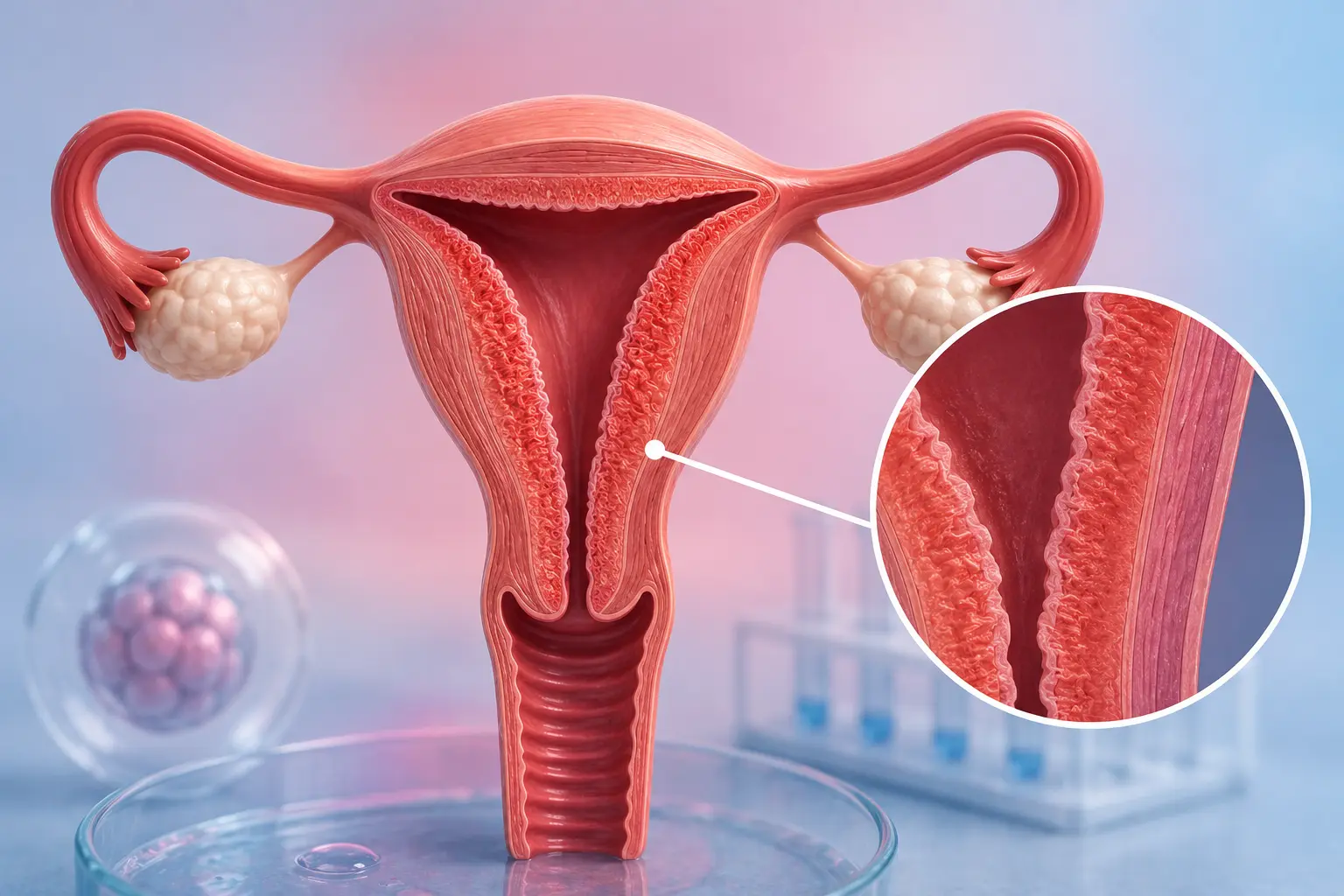
The endometrium, meaning the lining of your uterus, remodels itself every cycle to get ready for implantation, and in an IVF cycle we time that remodelling to your embryo’s development so the lining is receptive on the day of transfer. A lining that is too thin makes implantation less likely, and so does one with an abnormal structure, and that holds even when the embryo is chromosomally normal and beautifully graded. Indeed the embryo scoring clinic in Noida Delhi NCR and IVF laboratory can hand over excellent embryos and it still comes down to what the uterine side is doing.
What Is Considered an Adequate Endometrial Thickness for Transfer?
Most fertility specialists want a minimum of 7 to 8 millimetres by the day of transfer, measured on ultrasound across both layers of the endometrium, which is what the trilaminar pattern refers to. Having said that, it was never a hard cutoff and pregnancies have been reported on thinner linings. What the data does say is that outcomes below 7mm are consistently less favourable, and that below 6mm the probability of implantation drops off significantly. Pattern counts for as much as thickness does, with a trilaminar or triple-line appearance doing better than a homogeneous or echogenic one.
| Thickness | Pattern | Clinical Interpretation |
| ≥ 8mm, trilaminar | Triple-line visible | Good preparation; proceed to transfer |
| 7–8mm, trilaminar | Triple-line present | Acceptable; transfer typically proceeds |
| < 7mm, trilaminar | May be present | Borderline; individualised decision |
| < 6mm, any pattern | Often absent | Poor preparation; transfer deferral considered |
| Any thickness, homogeneous | No triple-line | Further evaluation warranted |
What Can Cause a Thin Endometrium?
What Are the Most Common Causes?
Several factors contribute to inadequate endometrial development:
- Insufficient oestrogen stimulation. Natural and minimally stimulated cycles especially
- Previous uterine surgery. Dilation and curettage, myomectomy, prior caesarean section scarring
- Asherman’s syndrome, where intrauterine adhesions stop the lining growing normally
- Chronic endometritis. A low-grade inflammation of the lining, and it often carries no symptoms at all
- Blood flow abnormalities. Reduced blood supply to the uterus limits how the endometrium responds to hormonal stimulation
- Clomiphene, or clomid, which thins the endometrium. One reason it is less favoured in IVF protocols today
What Can Be Done if the Lining Is Inadequate?
What Treatment Options Exist?
Management depends on the cause, but options include:
- Extending or adjusting the oestrogen supplementation. Dose, type, delivery route
- Low-dose aspirin or sildenafil, off-label, to improve uterine blood flow
- Platelet-rich plasma (PRP) instillation, or granulocyte colony-stimulating factor (G-CSF). Emerging treatments for a recurrent thin lining, promising early data, not standard practice yet
- Hysteroscopy. It diagnoses and treats Asherman’s syndrome, polyps, or fibroids affecting the cavity
- Freezing all the embryos, then transferring in a later cycle with the endometrial preparation controlled far more carefully
One scan showing a thinner lining than expected is not the end of a cycle, and the clinical team will usually keep monitoring you before they decide anything. That last option on the list is the one that reaches me most often, and I would rather have it than the alternative, because freezing everything and waiting for a better cycle costs you time and it does not cost you embryos.
Embryologist.co.in works closely with the clinical team so the embryo transfer is timed to coincide with optimal uterine preparation, because the best IVF clinic in Noida Delhi NCR understands that implantation is a two-sided equation.
This article is for general educational purposes and is not a substitute for personalised medical advice from your fertility specialist.