


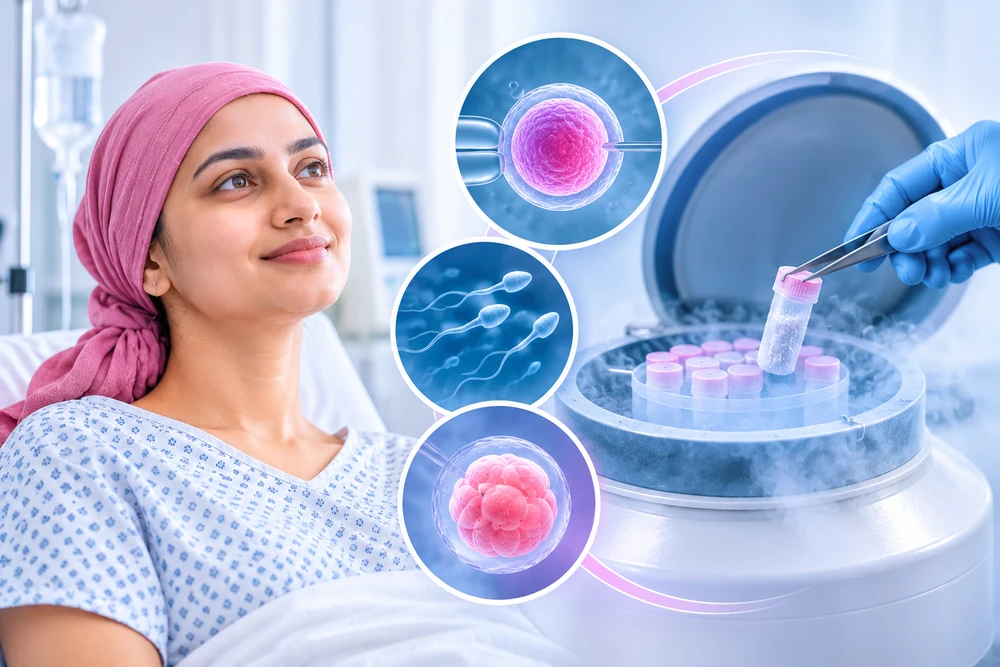
Written by Ram Prakash, Clinical Embryologist
A cancer diagnosis turns everything upside down. For many people of reproductive age, one of the first questions afterwards is whether they’ll still be able to have children. Very often the answer is yes, as long as fertility preservation happens before treatment starts. At our sperm freezing clinic in Noida Delhi, we see patients referred by oncology teams, and the same lesson comes up every time: the window for preserving fertility is shorter than people think, and sooner is nearly always better.
Why Does Cancer Treatment Threaten Fertility?
Chemotherapy and radiotherapy are built to destroy cells that divide quickly, which is why they work against cancer. The trouble is that reproductive cells divide quickly too, so they’re exposed to the same damage.
| Treatment Type | Mechanism of Fertility Risk |
| Alkylating chemotherapy agents (e.g. cyclophosphamide) | Directly toxic to sperm-producing cells and ovarian follicles |
| Radiation to or near the pelvis | Can damage the testes, ovaries, or uterus depending on field |
| Radiation to the brain (pituitary area) | Can disrupt hormonal signalling required for reproduction |
| Surgical treatment | Removal of reproductive organs in gynaecological or testicular cancers |
| Hormonal therapy (e.g. for breast cancer) | May suppress ovarian function during treatment |
How big the risk is depends on the exact drugs, the radiation field and dose, the patient’s age and how fertile they were before diagnosis. Oncologists and fertility specialists sort treatments into risk levels, so they can give patients a realistic picture before anything starts.
What Are the Fertility Preservation Options Before Cancer Treatment?
For Male Patients
Sperm freezing (cryopreservation) is quick, non-invasive and can be done within a day or two of referral. For most men it’s the first step, and often the only one needed. A sample is collected, processed and frozen before the first round of chemotherapy or radiotherapy, and it can be used later for IUI, IVF or ICSI whenever the patient is ready, even years or decades on.
At our sperm freezing clinic in Noida Delhi, we take urgent referrals from oncology teams and can finish the freezing quickly once the patient gets to us. There’s usually not much time before treatment, so these cases go to the front of the queue.
For men with very low counts, or who can’t give a sample the usual way, electroejaculation or surgical sperm retrieval under anaesthetic can be arranged, together with the oncology and urology teams.
For Female Patients
For women, preserving fertility before cancer treatment takes more time and more steps, although the options have grown a lot:
- Egg (oocyte) freezing, the most established option, which needs 10 to 14 days of stimulation injections, an egg retrieval and vitrification of the eggs, and suits single women or anyone without a partner
- Embryo freezing, where eggs are fertilised with partner or donor sperm before freezing, giving the same advantage as egg freezing plus the security of fertilisation having already happened, though it needs a partner or donor decision before treatment
- Ovarian tissue freezing, for patients who can’t put off chemotherapy for the stimulation period, where a small piece of ovarian cortex is removed and frozen to be put back after treatment, and which more specialist centres now offer
What Should Patients and Oncology Teams Know About Timing?
The single most important message is that fertility preservation needs to come up at diagnosis, not after the first round of treatment. Once treatment that harms the ovaries or testes has started, the options shrink fast, and sometimes disappear altogether.
For men, sperm banking can usually be done within 24 to 48 hours of deciding. For women, the stimulation-based options need 10 to 14 days, so the conversation with the oncology team has to start straight after diagnosis, not weeks later.
National and international oncofertility guidelines consistently say that fertility preservation should be discussed with every patient of reproductive age when cancer is diagnosed, before they consent to treatment.
Who Should Be Involved in This Conversation?
Preserving fertility before cancer treatment needs the oncologist, the fertility specialist, the embryologist and, where a partner is involved in the decision, the patient’s family all working together. At Embryologist.co.in and our sperm freezing clinic, we work alongside oncology teams to keep this as simple as we can for patients who are already dealing with an overwhelming amount. If time is short, book an appointment and we’ll see you quickly.
This article is for general educational purposes and is not a substitute for personalised medical advice from your oncologist, fertility specialist, or embryologist.