


Written by Ram Prakash, Clinical Embryologist
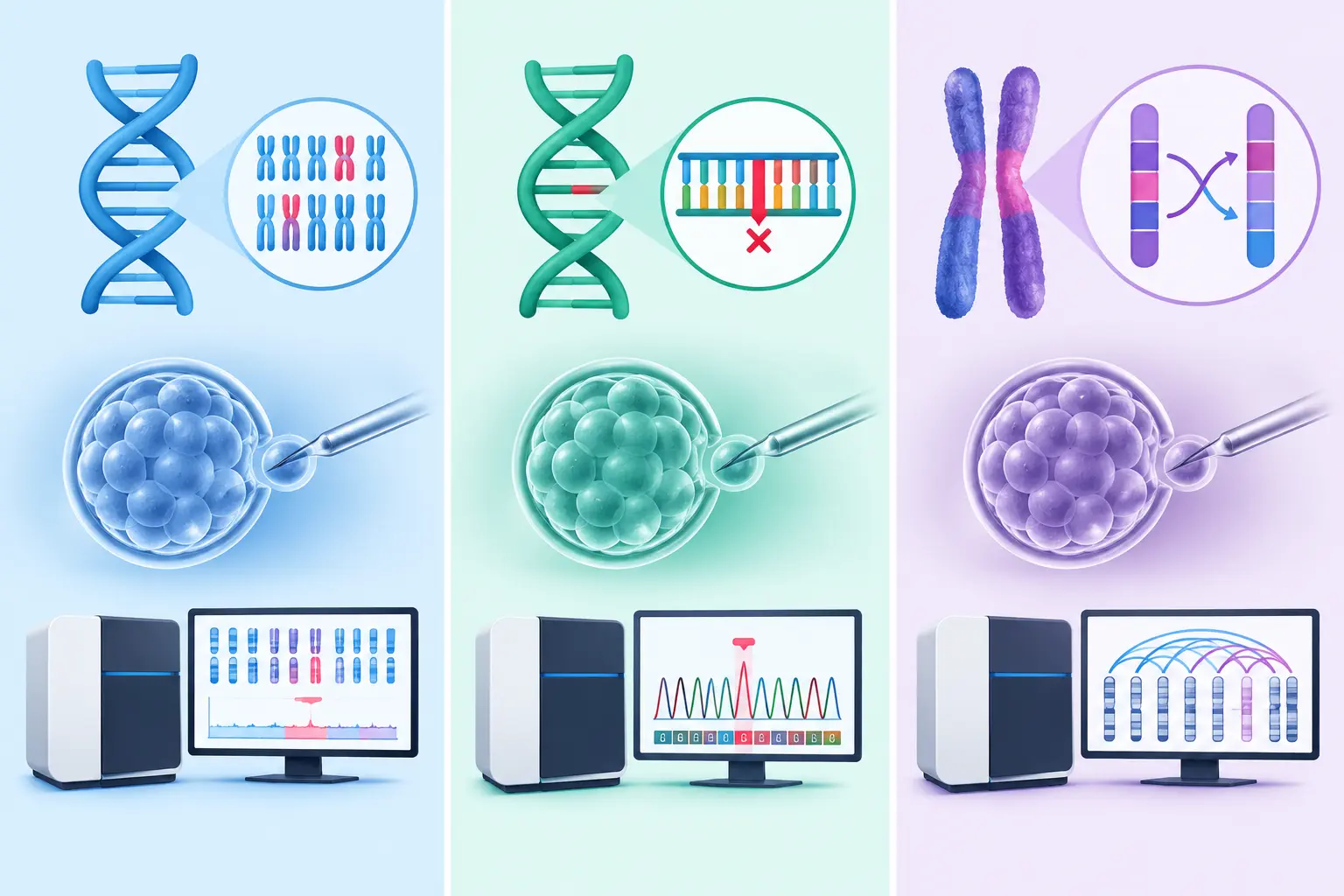
Do you know that PGT is not actually one single test at all? Preimplantation genetic testing has transformed the way embryos get selected before a transfer, however the term PGT covers three quite distinct tests which answer three completely different questions. Patients at any PGT testing clinic in Noida Delhi NCR deserve a clear explanation of which of the three types applies to their own situation and why it does, and they deserve that before they agree to testing which is going to add cost and complexity onto a process which is already demanding enough.
What Do PGT-A, PGT-M, and PGT-SR Each Test For?
| Type | Full Name | What It Screens | Primary Indication |
| PGT-A | Preimplantation Genetic Testing for Aneuploidy | Correct number of chromosomes (46 total) | Advanced maternal age, recurrent miscarriage, repeated IVF failure |
| PGT-M | Preimplantation Genetic Testing for Monogenic conditions | A specific single-gene mutation already known in the family | Known carrier couples, dominant condition in one partner |
| PGT-SR | Preimplantation Genetic Testing for Structural Rearrangements | Chromosomal structural abnormalities inherited from a parent | Balanced translocation or inversion in either partner |
What Is PGT-A and Who Does It Help?
PGT-A checks whether each of your embryos has the correct number of chromosomes in it. The chromosomal errors, which are called aneuploidy, are the leading cause of implantation failure and early pregnancy loss in IVF, and the rate of them increases significantly as maternal age goes up. Screening for aneuploidy before the transfer is what identifies the euploid embryos, meaning the ones which have a normal complement, and it reduces the number of transfers which are needed before a successful pregnancy in the patients who are at higher risk.
Who Gets the Most Benefit From PGT-A?
PGT-A is most clearly indicated for the following:
- Women who are over 35, where the aneuploidy rates in the embryos rise very sharply
- Patients who have had recurrent miscarriage, because most of the early losses are chromosomally abnormal embryos
- Couples who have had repeated unexplained IVF failure in spite of embryos which looked good
- Patients who want to maximise the efficiency of each transfer, and this matters particularly where the embryo numbers are limited
However, PGT-A is not universally recommended to everybody. For younger women who have good ovarian reserve and no prior failures behind them, the cumulative live birth rates across multiple unscreened transfers are comparable to the screened ones, so the additional cost and the freeze-all requirement may not be justified in their case.
What Is PGT-M and When Is It Used?
PGT-M screens for one specific single-gene condition which has already been identified within the family. Unlike PGT-A, which is a general chromosomal screen, PGT-M is custom-built for each individual couple, because the laboratory designs a test which is specific to the exact mutation that is involved, and this takes several weeks before any cycle is able to begin.
The common situations which require PGT-M include:
- Both partners are carriers of the same autosomal recessive condition, whether that is thalassaemia, sickle cell disease, cystic fibrosis or spinal muscular atrophy, where a child could end up inheriting both of the copies
- One partner has or carries an autosomal dominant condition such as Huntington’s disease, where a single copy is sufficient to cause the disease
- The mother is a confirmed carrier of an X-linked condition which affects the male offspring
Genetic counselling is required before PGT-M so that the exact nature of the mutation and its inheritance pattern can both be confirmed. Moreover, confirmatory prenatal testing during the pregnancy, whether via CVS or amniocentesis, remains recommended even after a PGT-M cycle.
What Is PGT-SR and Who Does It Apply To?
PGT-SR is used where one parent carries a structural chromosomal rearrangement, and most commonly that is a balanced translocation, which is where segments of two chromosomes have swapped their positions. The carrier parent is typically unaffected themselves but they are at elevated risk of passing an unbalanced arrangement on to their offspring, and that is what causes miscarriage or developmental abnormality. PGT-SR is what identifies the embryos which have a balanced or normal chromosome complement for the transfer.
At the best IVF clinic in Noida Delhi NCR, and through our PGT programme at Embryologist.co.in, the starting point for any genetic testing discussion is always the same two questions. Which of the types applies to this couple’s specific situation, and does the benefit justify what it is adding to a treatment cycle which is already complex. Every good PGT testing clinic in Noida Delhi NCR starts that conversation before any of the testing has begun.
This article is for general educational purposes and is not a substitute for personalised medical advice from your fertility specialist, embryologist, or genetic counsellor.